This is another post in a series on Resilience4j with SpringBoot. Resilience4j provides common resilience patterns that can be used with SpringBoot. In this post I want to look at the Circuit Breaker pattern.
A Circuit Breaker stops an application from repeatedly calling a dependency that is already failing. Instead of sending every request over the network and waiting for another error, the circuit breaker reacts to recent outcomes. When failures cross a configured threshold, it opens and rejects new calls immediately.
This demo uses two Spring Boot services:
rest-serviceaccepts orders, saves them to Postgres, and calls the email-service.email-servicedelays by 1 second, then pretends to send order confirmation emails.
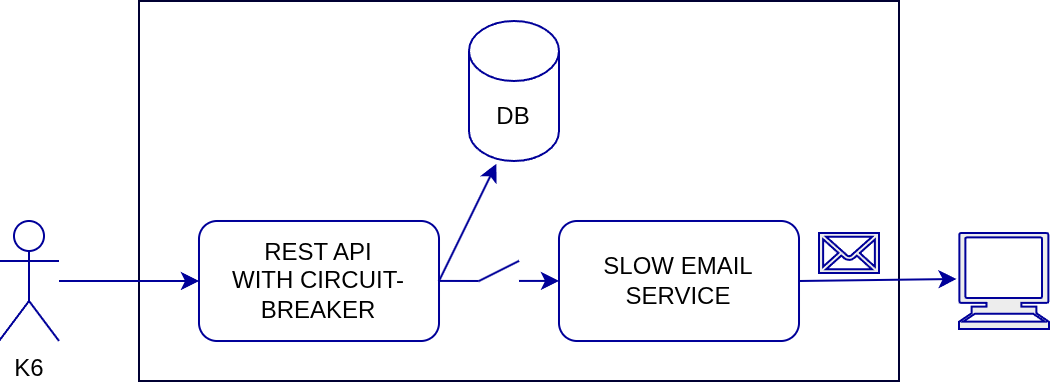
The code can be found here.
Configuration for the Circuit Breaker is in application.yaml:
resilience4j:
  circuitbreaker:
    instances:
      emailService:
        sliding-window-type: count_based
        sliding-window-size: 4
        minimum-number-of-calls: 4
        failure-rate-threshold: 50
        wait-duration-in-open-state: 2s
        permitted-number-of-calls-in-half-open-state: 2
        automatic-transition-from-open-to-half-open-enabled: true
The breaker looks at the last 4 calls. Once at least 4 calls have been recorded, a failure rate of 50% or more opens the circuit. While open, calls do not go to the email-service. After 2 seconds, the breaker moves to half-open and allows 2 trial calls through. If those trial calls succeed, the circuit closes again.
The Protected Call
The SpringBoot @CircuitBreaker annotation is added to the rest-service method that calls the email-service.
@CircuitBreaker(name = "emailService", fallbackMethod = "emailFallback")
public EmailDeliveryResult sendOrderConfirmation(Order order) {
    log.info("calling email-service orderId={}", order.getId());

    emailRestClient.post()
            .uri("/emails")
            .body(request)
            .retrieve()
            .toBodilessEntity();

    return EmailDeliveryResult.sent();
}
The @CircuitBreaker annotation puts calls to sendOrderConfirmation behind the emailService circuit breaker. When the downstream call succeeds, the order response shows SENT. When the downstream call fails, times out, or is rejected because the circuit is open, Resilience4j invokes the fallback.
EmailDeliveryResult emailFallback(Order order, Throwable cause) {
    log.warn("email delivery deferred orderId={} reason={}",
            order.getId(), cause.getClass().getSimpleName());
    return EmailDeliveryResult.deferred(cause.getClass().getSimpleName());
}
The API still returns 201 Created because the order has been saved. But the email notification is deferred or lost.
Running the System
Start the stack:
docker compose up --build
Then run the k6 load test:
k6 run k6/circuit-breaker.js
If the downstream service is unavailable, the useful log lines look like this:
rest-service  | WARN - ...rest.CircuitBreakerEventLogger : circuit breaker error name=emailService state=CLOSED failureRate=-1.0
rest-service  | WARN - ...rest.EmailClient               : email delivery deferred orderId=1 reason=ServiceUnavailable
rest-service  | INFO - ...rest.OrderController           : create order called orderId=1 customerEmail=circuit-breaker-1-0-1787743330000@example.com amount=42.50

rest-service  | WARN - ...rest.CircuitBreakerEventLogger : circuit breaker state transition name=emailService transition=State transition from CLOSED to OPEN
rest-service  | WARN - ...rest.CircuitBreakerEventLogger : circuit breaker call not permitted name=emailService state=OPEN
rest-service  | WARN - ...rest.EmailClient               : email delivery deferred orderId=5 reason=CallNotPermittedException
rest-service  | INFO - ...rest.OrderController           : create order called orderId=5 customerEmail=circuit-breaker-5-0-1787743330500@example.com amount=42.50
There are two different failures shown here.
The first is a downstream failure. The rest-service calls email-service, and email-service returns an error. The circuit breaker records that error.
The second is an open-circuit rejection. The rest-service does not call email-service at all. Resilience4j rejects the call locally with CallNotPermittedException, and the fallback marks the email as deferred.
Note the REST service also exposes actuator endpoints for circuit breaker state and events:
http://localhost:8081/actuator/circuitbreakers
http://localhost:8081/actuator/circuitbreakerevents
When the downstream service is healthy again and the wait duration has passed, the circuit breaker allows trial calls:
rest-service  | WARN - ...rest.CircuitBreakerEventLogger : circuit breaker state transition name=emailService transition=State transition from OPEN to HALF_OPEN
rest-service  | INFO - ...rest.CircuitBreakerEventLogger : circuit breaker success name=emailService state=HALF_OPEN failureRate=-1.0
rest-service  | WARN - ...rest.CircuitBreakerEventLogger : circuit breaker state transition name=emailService transition=State transition from HALF_OPEN to CLOSED
The circuit breaker has recovered automatically because the downstream service started succeeding again.
Observing the K6 Results
Looking at the K6 results we can see that not all emails were sent:
 █ THRESHOLDS

    deferred_email_responses
    ✗ 'count==0' count=16

    open_circuit_responses
    ✗ 'count==0' count=10

    sent_email_responses
    ✓ 'count>0' count=64

    unexpected_responses
    ✗ 'rate<0.01' rate=20.00%


  █ TOTAL RESULTS

    checks_total.......: 80     7.799919/s
    checks_succeeded...: 80.00% 64 out of 80
    checks_failed......: 20.00% 16 out of 80

    ✗ order created with sent email
      ↳  80% — ✓ 64 / ✗ 16
Checking the Database
Postgres is also useful for checking the final state after the run:
docker compose exec postgres psql -U demo -d orders \
  -c "select email_status, count(*) from orders group by email_status order by email_status;"
  email_status  | count
----------------+-------
 EMAIL_DEFERRED |    16
 SENT           |    64
(2 rows)
You can also compare total orders with sent emails directly:
docker compose exec postgres psql -U demo -d orders \
  -c "select count(*) as orders_processed, count(*) filter (where email_status = 'SENT') as emails_sent from orders;"
 orders_processed | emails_sent
------------------+-------------
               80 |          64
(1 row)
So clearly, not all of the emails have been sent.
Conclusion
In this demo, the intentionally slow email service causes the order API to pile up behind it. Adding a circuit-breaker makes this behavior visible, and protects the calling service.
Addendum: How is this different from a Bulkhead?
Circuit-breaker and bulkhead are complementary resilience patterns, but address different types of failure. Circuit Breakers prevent repeated calls to failing dependencies by opening the circuit when error rates exceed a threshold, enabling fail-fast behavior and giving the external service time to recover. Bulkheads isolate system resources (such as thread pools or connection pools) into independent compartments, ensuring that a slowdown or failure in one dependency does not exhaust resources and starve other critical services.