This is the first of a series of posts on Resilience4j with SpringBoot. Resilience4j provides some common resilience patterns that can be used with SpringBoot. In this post I want to look at the Bulkhead pattern.
A Bulkhead limits how much shared capacity a particular operation or dependency can consume at once. If a slow downstream service starts tying up threads or HTTP connections, a bulkhead caps the number of concurrent calls allowed to reach it, helping protect the rest of the application[1].
This demo uses two Spring Boot services:
rest-serviceaccepts orders, saves them to Postgres, and calls the email-service.email-servicedelays by 1 second, then pretends to send order confirmation emails.
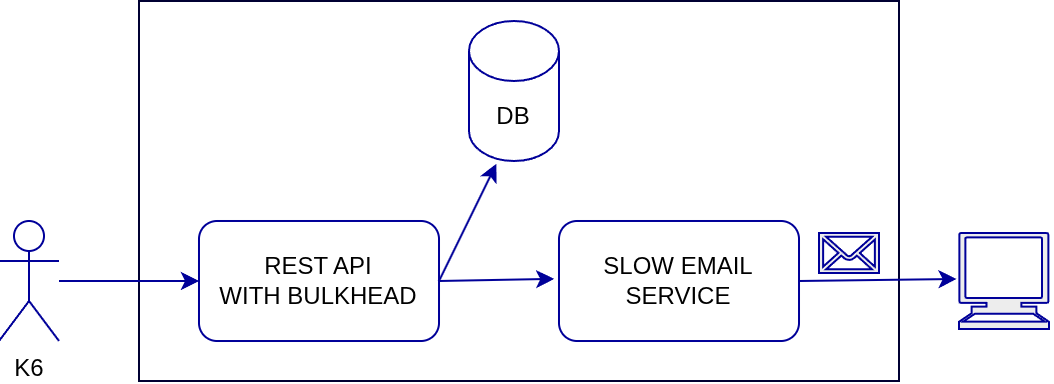
The code can be found here.
Configuration for the Bulkhead is in application.yaml:
resilience4j:
  bulkhead:
    instances:
      emailService:
        max-concurrent-calls: 4
        max-wait-duration: 700
Here only 4 calls to the email service can run at the same time. Extra calls are queued for 700ms then rejected.
The Protected Call
The SpringBoot @Bulkhead annotation is added to the rest-service method that calls the email-service.
@Bulkhead(name = "emailService", fallbackMethod = "emailFallback")
public EmailDeliveryResult sendOrderConfirmation(Order order) {
    log.info("calling email-service orderId={}", order.getId());

    emailRestClient.post()
            .uri("/emails")
            .body(request)
            .retrieve()
            .toBodilessEntity();

    return EmailDeliveryResult.sent();
}
The @Bulkhead annotation puts calls to sendOrderConfirmation behind the emailService bulkhead. If there is capacity, the downstream call runs and the order response shows SENT. If the bulkhead is already full, Resilience4j queues the new request for 700ms, then skips the downstream call and invokes the fallback.
EmailDeliveryResult emailFallback(Order order, Throwable cause) {
    log.warn("email delivery deferred orderId={} reason={}",
            order.getId(), cause.getClass().getSimpleName());
    return EmailDeliveryResult.deferred(cause.getClass().getSimpleName());
}
The API still returns 201 Created because the order has been saved. But the email notification is deferred or lost.
Running the System
Start the stack:
docker compose up --build
Then run the k6 load test:
k6 run k6/bulkhead.js
The k6 test should produce both outcomes - some orders with emailStatus set to SENT and some orders with emailStatus set to EMAIL_DEFERRED.
This is the bulkhead doing its job. It allows a specific amount of downstream work through, rejects the overflow after a 700ms queue, and keeps the order API responsive. The K6 tests should generates enough concurrent requests to exhaust the bulkhead.
In this case, orders 49 through 55 provide a useful example:
# orderId=49 is permitted, but consumes the last available permit
rest-service  | INFO - ...rest.BulkheadEventLogger : bulkhead permitted call orderId=49 name=emailService availableConcurrentCalls=0
rest-service  | INFO - ...rest.EmailClient         : calling email-service orderId=49
email-service | INFO - ...email.EmailController    : email-service processing order orderId=49 delayMs=700

# orderId=50 is rejected because the bulkhead is full
rest-service  | WARN - ...rest.BulkheadEventLogger : bulkhead rejected call orderId=50 name=emailService availableConcurrentCalls=0
rest-service  | WARN - ...rest.EmailClient         : email delivery deferred orderId=50 reason=BulkheadFullException
rest-service  | INFO - ...rest.OrderController     : create order called orderId=50 customerEmail=bulkhead-6-1-1787743330298@example.com amount=42.50

# orderId=51 is also rejected
rest-service  | WARN - ...rest.BulkheadEventLogger : bulkhead rejected call orderId=51 name=emailService availableConcurrentCalls=0
rest-service  | WARN - ...rest.EmailClient         : email delivery deferred orderId=51 reason=BulkheadFullException
rest-service  | INFO - ...rest.OrderController     : create order called orderId=51 customerEmail=bulkhead-10-1-1787743330398@example.com amount=42.50
As existing calls finish, permits become available again and subsequent requests can enter the bulkhead:
rest-service  | INFO - ...rest.BulkheadEventLogger : bulkhead permitted call orderId=52 name=emailService availableConcurrentCalls=0
rest-service  | INFO - ...rest.EmailClient         : calling email-service orderId=52
email-service | INFO - ...email.EmailController    : email-service processing order orderId=52 delayMs=700

rest-service  | INFO - ...rest.BulkheadEventLogger : bulkhead permitted call orderId=53 name=emailService availableConcurrentCalls=0
rest-service  | INFO - ...rest.EmailClient         : calling email-service orderId=53
email-service | INFO - ...email.EmailController    : email-service processing order orderId=53 delayMs=700

rest-service  | INFO - ...rest.BulkheadEventLogger : bulkhead permitted call orderId=54 name=emailService availableConcurrentCalls=0
rest-service  | INFO - ...rest.EmailClient         : calling email-service orderId=54
email-service | INFO - ...email.EmailController    : email-service processing order orderId=54 delayMs=700

rest-service  | INFO - ...rest.BulkheadEventLogger : bulkhead permitted call orderId=55 name=emailService availableConcurrentCalls=0
rest-service  | INFO - ...rest.EmailClient         : calling email-service orderId=55
email-service | INFO - ...email.EmailController    : email-service processing order orderId=55 delayMs=700
When the outstanding calls finish, the permits are released:
rest-service  | INFO - ...rest.BulkheadEventLogger : bulkhead finished call orderId=52 name=emailService availableConcurrentCalls=1
rest-service  | INFO - ...rest.BulkheadEventLogger : bulkhead finished call orderId=53 name=emailService availableConcurrentCalls=2
rest-service  | INFO - ...rest.BulkheadEventLogger : bulkhead finished call orderId=54 name=emailService availableConcurrentCalls=3
rest-service  | INFO - ...rest.BulkheadEventLogger : bulkhead finished call orderId=55 name=emailService availableConcurrentCalls=4
The final line is particularly significant:
availableConcurrentCalls=4
All four permits are available again. The bulkhead has recovered automatically because the pressure on the downstream service has subsided. However, just in these log fragments orders 50 and 51 have received no email. So we would still need to do something about orders marked EMAIL_DEFERRED.
Observing the K6 results
Looking at the K6 results we can confirm that not all the emails got delivered:
█ THRESHOLDS

    bulkhead_rejected_email_responses
    ✓ 'count>0' ***count=32***

    sent_email_responses
    ✓ 'count>0' ***count=63***

    unexpected_responses
    ✓ 'rate<0.01' rate=0.00%


█ TOTAL RESULTS

    checks_total.......: ***95***      8.055647/s
    checks_succeeded...: 100.00% 95 out of 95
    checks_failed......: 0.00%   0 out of 95

    ✓ order created with sent or bulkhead-deferred email
So while we have maintained control of the calling service, the Bulkhead alone does not stop loss of emails.
Conclusion
In this demo, the intentionally slow email service causes the order API to pile up behind it. Adding a bulkhead makes this behavior visible, and protects the calling service.
Notes
- In Resilience4j, a
semaphore bulkheaddoes this without creating its own threads; it simply acts as a concurrency gate, whereas athread-pool bulkheadprovides stronger isolation by running the protected work on a dedicated bounded thread pool. I use a semaphore in this example.